Fado Above the Roman Theatre
 My friend Zoka found a place in Lisbon where we could have dinner and listen to fado at the same time. Proud of my ability to manage everything, I carefully wrote a message in Portuguese and reserved four seats under my name.
The only thing I failed to notice was that, while following the original internet search, I was looking at one address, whereas the reservation confirmation had been sent for a completely different one:
Associação do Fado Casto, Rua de São Mamede 8A, Alfama, next to the Museum of the Roman Theatre.
When we arrived at the first address, we quickly realised that nobody there was expecting four people under the name Nenad. Only then did I read the confirmation more carefully and understand that we had booked a different fado programme in another part of Alfama.
We started walking uphill through the narrow, steep streets of old Lisbon and eventually reached the Associação do Fado Casto. Instead of a conventional restaurant dining room, we entered a vaulted space that had once been part of a church, with several groups of people gathered around long tables. In one section, the pulpit was still preserved, together with an interesting representation of the Virgin Mary holding the infant Jesus. What made the space unlike any ordinary church, however, were its walls, covered with plaques, photographs and portraits of fado singers and musicians.
The food had already been placed on the tables, together with small barrels of red wine. There was little ceremony, but it was immediately clear that people had not gathered there merely to have dinner.
They had come to listen to fado.
The true uniqueness of the place, however, lies beneath its floors. The building stands above the remains of the Roman theatre of the ancient city of Felicitas Iulia Olisipo, as Lisbon was known during the Roman Empire. The theatre was built at the beginning of the first century AD and could accommodate approximately 4,000 spectators. Today, some of its remains form part of the Museu de Lisboa – Teatro Romano, while other sections are still hidden beneath the surrounding buildings.
We were therefore sitting among the layers of the city, above a stage where Roman tragedies and comedies had been performed almost two thousand years earlier, while waiting to hear music that expresses one of Portugal’s most recognisable emotions.
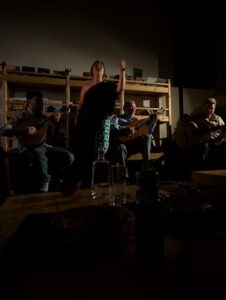
The concert began after almost an hour, which we had spent having dinner. The lights went out, the conversations stopped, and in front of us remained the singer, accompanied by three traditional fado instruments: the bright, distinctive Portuguese guitar, the classical viola de fado, and the four-string viola baixo, whose deep, almost double-bass-like sound gave the music fullness and a calm rhythmic foundation.
Nobody ate. Nobody spoke.
Fado is listened to in silence.
After four songs, there was a break. Following the initial appetisers—fish croquettes, fried cod and green beans—we were served chicken wings and braised meat. The lights came back on, people resumed their conversations, poured more wine and tried to interpret what they had just heard, although probably no one who did not speak Portuguese had actually understood the words.
But fado, it seems, does not always need to be understood in order to be felt.
Then the lights went out once again. The conversations stopped immediately, and the second part of the concert began, this time with a female singer.
After the male singer, a female singer appeared and performed two songs. During the second, she turned towards the audience and invited us to repeat the refrain with her. The words that I had initially heard as “ken tu fado” were apparently “Quem vai ao fado”—which could be translated naturally as “Whoever comes to hear fado.”
The song speaks of the person who comes to listen to fado and feels something unusual beating within the chest, as though the soul itself had grown wings. Suddenly, we were no longer merely guests seated at tables or an audience listening in silence. We had become part of the song, even though most of us were pronouncing the Portuguese words more by ear than with any real understanding.
That was the true magic of the evening. Fado was no longer simply a performance taking place in front of us; it was something happening among us. The singer began the refrain, the audience responded, and the guitars connected the voices of people who, until that moment, had mostly been strangers to one another.
It then became completely clear that this was not dinner accompanied by music. It was exactly the opposite: dinner was merely an intermission between the songs, and by the end, the audience itself had become part of the concert.
Perhaps this is the best way to discover fado—not in a large concert hall and not as a tourist performance beginning precisely on schedule, but around a shared table, among people you have never met before, with simple food and wine, while beneath you rests a theatre almost two thousand years old.
The Romans once listened to tragedies on this site. Today, the Portuguese sing about love, separation, the sea, fate and longing.
Centuries have passed. The city has changed. The theatre was buried, and new houses were built above it. Yet the human need to gather, fall silent and listen to stories about life has apparently remained unchanged.
Perhaps that is why fado sounded so natural in this particular place—as though it were the continuation of a performance that had begun almost two thousand years ago.
At the very end, they served arroz doce, the Portuguese version of rice pudding, scented with lemon and sprinkled with cinnamon. It was a simple, homely conclusion to the evening—unpretentious, yet entirely in harmony with the setting, the food and the music.
All in all, something that had initially looked like a conventional tourist arrangement turned out to be completely different. We attended a genuine fado concert, accompanied by a good dinner, in an extraordinary space with an even more remarkable history.
It is an experience I would wholeheartedly recommend to anyone who has the opportunity to visit—not only to those following the usual tourist itinerary through Lisbon, but also to anyone who wants to understand something deeper about the city, its music and its soul.
Fado iznad rimskog pozorišta
Moja prijateljica Zoka pronašla je mesto u Lisabonu na kojem smo mogli istovremeno da večeramo i slušamo fado. Ja sam, ponosan na svoje snalaženje, uredno napisao poruku na portugalskom i rezervisao četiri mesta pod svojim imenom.
Jedino nisam primetio da sam, prateći prvobitnu internet-pretragu, gledao jednu adresu, dok je potvrda rezervacije stigla za sasvim drugu:
Associação do Fado Casto, Rua de São Mamede 8A, Alfama, pored Muzeja rimskog pozorišta.
Kada smo stigli na prvobitnu adresu, brzo smo shvatili da tamo niko ne očekuje četvoro ljudi na ime Nenad. Tek tada sam pažljivije pročitao poruku i shvatio da smo rezervisali drugi fado program, u drugom delu Alfame.
Krenuli smo uzbrdo, kroz uske i strme ulice starog Lisabona, i konačno stigli u Associação do Fado Casto. Unutra nas nije dočekala klasična restoranska sala, već nekoliko grupa ljudi okupljenih oko dugih stolova u prostoru svodova bivše crkve. U jednom delu je još uvek bila propovedaonica i intersantna instalacija Bogorodice sa Isusom u naručju. Ono što je bilo drugačije od bilo koje crkve su bili zidovi na kojima su bile ploče i slike fado pevača i muzičara.
Hrana je već bila postavljena, a na stolovima su stajali burići crnog vina. Nije bilo mnogo ceremonije, ali je odmah bilo jasno da smo došli na mesto na kojem se ljudi ne okupljaju samo da bi večerali.
Okupljaju se da bi slušali fado.
Posebnost ovog mesta nalazi se, međutim, ispod njegovih podova. Zgrada je podignuta nad ostacima rimskog pozorišta antičkog grada Felicitas Iulia Olisipo, kako se Lisabon nazivao u vreme Rimskog carstva. Pozorište je izgrađeno početkom prvog veka nove ere i moglo je da primi oko 4.000 gledalaca. Danas je deo njegovih ostataka uključen u Museu de Lisboa – Teatro Romano, dok se drugi delovi i dalje nalaze ispod okolnih zgrada.
Sedeli smo, dakle, na slojevima grada, iznad pozornice na kojoj su pre gotovo dve hiljade godina izvođene rimske tragedije i komedije, a sada smo čekali da čujemo muziku koja predstavlja jednu od najprepoznatljivijih emocija Portugala.
Koncert je počeo nakon gotovo sat vremena koje smo iskoristili da večeramo. Svetla su se ugasila, razgovori su prestali, a pred nama su ostali pevač a muzičku pratnju činila su tri tradicionalna fado instrumenta – zvonka portugalska gitara, klasična viola de fado i četvorožičana viola baixo, čiji je duboki, gotovo kontrabasovski zvuk daje muzici punoću i miran ritmički oslonac.
Niko nije jeo. Niko nije razgovarao.
Fado se sluša u tišini.
Posle četiri pesme napravljena je pauza. Nakon početnog mezea, ribljih kroketa, prženog bakalara i mahuna, poslužena su pileća krilca i dinstano meso. Svetla su se ponovo upalila, ljudi su razgovarali, sipali vino i pokušavali da prevedu ono što su upravo čuli, iako verovatno niko ko ne govori portugalski nije razumeo reči.
Ali fado se, izgleda, ne mora uvek razumeti da bi se osetio.
Zatim su se svetla ponovo ugasila. Razgovori su u trenutku prestali i počeo je drugi deo koncerta uz pevačicu.
U tom trenutku postalo je jasno da ovo nije bila večera uz muziku. Bilo je upravo obrnuto: večera je bila samo predah između pesama.
I možda je baš to najbolji način da se upozna fado. Ne u velikoj koncertnoj dvorani, ne kao turistička predstava koja počinje tačno u minut, već za zajedničkim stolom, među ljudima koje prvi put vidite, uz jednostavnu hranu i vino, dok ispod vas počiva pozorište staro dve hiljade godina.
Rimljani su na tom mestu slušali tragedije. Portugalci danas pevaju o svojim ljubavima, rastancima, moru, sudbini i čežnji.
Vekovi su prošli, grad se promenio, pozorište je zatrpano i preko njega su podignute nove kuće. Ali potreba ljudi da se okupe, ućute i slušaju priče o životu očigledno je ostala ista.
Možda je zato fado baš na ovom mestu zvučao tako prirodno — kao nastavak predstave koja je počela pre skoro dve hiljade godina.
Zatim su se svetla ponovo ugasila. Razgovori su u trenutku prestali i počeo je drugi deo koncerta. Posle muškog pevača izašla je pevačica i otpevala dve pesme. U drugoj se okrenula prema publici i pozvala nas da zajedno sa njom ponavljamo refren. Reči koje sam u početku čuo kao „ken tu fado“ zapravo su, po svemu sudeći, bile „Quem vai ao fado“ — „Ko ide na fado“. Pesma govori o tome da čovek koji dolazi da sluša fado nosi u grudima nešto neobično što pulsira i oseća kako mu duša dobija krila. Odjednom više nismo bili samo gosti za stolovima i publika koja ćutke sluša. Postali smo deo pesme, makar smo portugalske reči izgovarali više po sluhu nego sa razumevanjem.
Upravo je u tome bila čar te večeri. Fado više nije bio nastup koji se odvijao pred nama, već nešto što se dešavalo među nama. Pevačica je započinjala stih, publika ga je prihvatala, a dve gitare su povezivale glasove ljudi koji su se do tog trenutka uglavnom međusobno nisu ni poznavali.
U tom trenutku postalo je potpuno jasno da ovo nije bila večera uz muziku. Bilo je upravo obrnuto, večera je bila samo predah između pesama, a publika je na kraju postala deo koncerta.
Za sam kraj doneli su arroz doce, portugalsku verziju sutlijaša, mirisnu na limun i posutu cimetom. Bio je to jednostavan, domaći završetak večeri — bez pretencioznosti, ali potpuno u skladu sa ambijentom, hranom i muzikom.
Sve u svemu, nešto što je ličilo na klasičnu turističku šemu, ispalo je potpuno drugačije. Prisustvovali smo zaista fado koncertu uz dobru večeru u nevrovatnom prostoru sa još neverovatnijom istorijom. Zaista preprouka sve koji imaju priliku čak ako i ne idu u klasičnu turističku posetu Lisabonu