Why The Balkan Cowboy Is the Best Film I Have Seen at This Year’s Sarajevo Film Festival
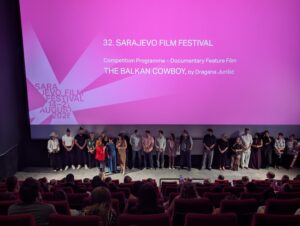 Dragana Had to Come from Ireland to Make a Film About Us.This was the eleventh film I had seen since the beginning of the Festival — and the fifth one that day. Some had been difficult, some politically important; some had made me think long after the screening about guilt, forgiveness, violence, family, and the society we live in.
And then I watched Dragana Jurišić’s The Balkan Cowboy.
And I realised that, for me, it was the best film of the Festival. I am not claiming that it is objectively the best. Such a category probably does not even exist in art. It is the best for me because it is about us. About a country that no longer exists. About people who are no longer here. About a time we once lived through, which has meanwhile become history.
And it took Dragana Jurišić coming back from Ireland to make a film about it.
Hari Džekson, the Cowboy from Bijeljina
At first glance, it is difficult to imagine a more unusual protagonist for a documentary.Hari Džekson — an Albanian whose real name was Aljuš Musli — made Westerns in Bijeljina. In Yugoslavia. With people from his own community. Cowboys, Native Americans, revolvers, horses, shootouts — the entire mythology of the American West transplanted onto the plains of Bosnia. It would have been easy to make a charming documentary about an eccentric man. But that is not the film Dragana Jurišić made. Hari merely opened the door for her. Behind that door lies a much bigger story.
A Country That No Longer Exists
Dragana Jurišić was born in Slavonski Brod in 1975. Her mother is Serbian, her father was Croatian, while she considers herself Yugoslav.
The war did not simply change the country she lived in. Her family apartment burned down, together with thousands of photographs and negatives taken by her father, an amateur photographer. The home disappeared. The photographs disappeared. The country disappeared. And with them disappeared a part of her personal identity.
Perhaps that is why photography and film have a different meaning in Dragana Jurišić’s work. A camera is not merely an instrument for recording reality. It is a means of trying to preserve what is disappearing — or of finding what has already disappeared.
And her connection with Hari Džekson is even more intimate. Her father knew him. He learned how to use a camera from Hari.
And so an almost incredible line emerges:
Hari Džekson – her father – Dragana – the film we are watching today.
The camera passes from one hand to another.
Like a family inheritance.
The People in Those Old Films Do Not Know What Is Going to Happen to Them
For me, this was the most heartbreaking part. We watch the old footage. People play cowboys and Native Americans. They run, shoot, fall, laugh. They take part in somebody’s crazy dream of making a Western in Bijeljina. And at that moment they do not know what we know today.
They do not know what will happen to their country. They do not know what will happen to their town. They do not know what will happen to their friends and neighbours.They do not know how quickly identities that might have seemed almost irrelevant at the time — Serb, Croat, Muslim — would become questions capable of determining people’s destinies.
But we know. And that knowledge suddenly makes those old, somewhat naïve films unbearably sad.
An Emotional Genius
As we were leaving the cinema, I said that Dragana Jurišić was an emotional genius. I still believe that. Not because she is trying to make us cry. Quite the opposite. She knows when to step aside.
She does not explain every emotion to us. She does not tell us what we should think about Yugoslavia. She does not try to prove that the country was either good or bad. She does not make a political treatise.
She does something much more difficult. She tries to reconstruct the feeling of a world. And you cannot prove a feeling with an archival document.
You can find it in someone’s face, in an old photograph, in a house, in an empty space, in a voice, in a person remembering something that no longer exists. And in silence.
Dragana shows us all of this.
This Is Not Nostalgia for Yugoslavia
This is important to me. It would be very easy to dismiss a film like this as Yugonostalgia. I think that would be superficial. Nostalgia usually says that things were better once.This film does not say that. Instead, it asks a far more uncomfortable question:
What happens to a person when the country to which they belonged ceases to exist?
Countries can disappear almost overnight. Flags change, passports change, borders move, streets acquire new names. But what do we do with the life we lived in that country?
We cannot erase it together with the country’s name. That is why people of my generation probably experience this film differently from someone born after the breakup of Yugoslavia.
For a young person, this may be an extraordinary documentary about an unusual man who made Westerns in Yugoslavia. For me, it is not. I am not watching history. I am watching a part of my life that has become history.
Dragana Had to Come from Ireland
And there is an irony here that I cannot ignore. Dragana Jurišić has lived in Ireland since 1999. So it took a woman who had left this part of the world to come back and make a film about something that perhaps those of us who stayed behind have stopped noticing. Perhaps she had to go far enough away in order to see it clearly.
Because people who live every day among the remains of a vanished world eventually stop seeing its ruins. They get used to them. Dragana did not. She came back for them. For Hari. For her father. For the photographs that no longer exist. For a Bijeljina that is no longer the Bijeljina it once was. And, in a way, for a Yugoslavia that now exists only in the people who remember it.
Why The Balkan Cowboy Is My Film of the Festival
Over these days, I have watched films about the collapse of society, violence, guilt, forgiveness, family, and human loneliness.
Some of them may win more awards. Some may have greater international careers. But only one film made me stop thinking about its protagonists as them. Because very quickly I realised:
This is not a film about them. This is a film about us. About a country that no longer exists.About people who are no longer here. About a time when we were younger and did not know what was going to happen to us. About the photographs we keep because we are afraid that without them, a part of our own lives might disappear as well. And about a man from Bijeljina who wanted to be a cowboy.
Hari Džekson made his Westerns without knowing that, many years later, a young woman whose father had learned how to use a camera from him would follow in his footsteps. And that through him she would try to find something much bigger: a country, a father, a childhood, Us.
That is why The Balkan Cowboy is, for me, the best film of this year’s Sarajevo Film Festival.
Not because it explained the world to me better than any other film.
But because it reminded me of the world I once had.