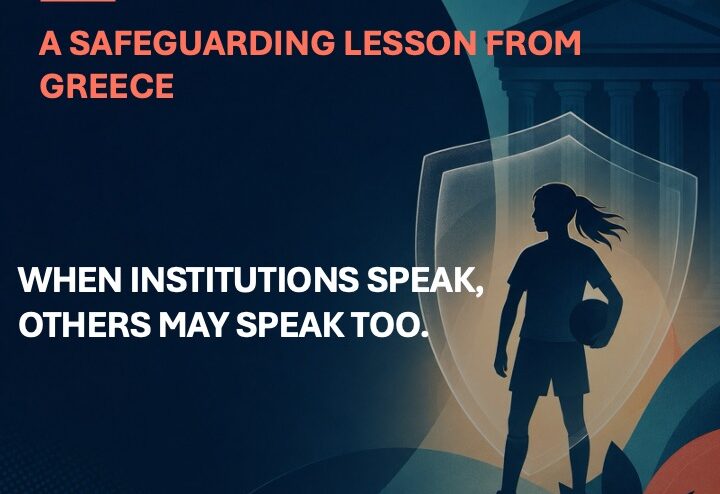
When Institutions Act: A Safeguarding Lesson from Greece
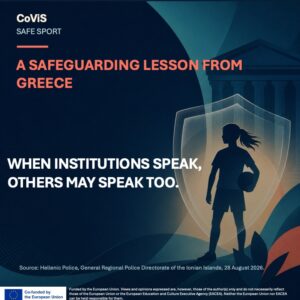 A recent case in Greece shows that safeguarding does not end when abuse is reported. What institutions do next can be just as important.
On 28 August 2026, the Hellenic Police publicly released information concerning a sports coach/instructor in Kefalonia who is facing serious criminal charges involving alleged sexual offences against minors.
The announcement followed an order by the Public Prosecutor’s Office of Kefalonia, subsequently confirmed by the Patras Court of Appeal Prosecutor’s Office. According to the official police statement, the man had been arrested on 3 July 2026 by officers of the Argostoli Crime Investigation and Detection Department. The charges include alleged repeated rape and attempted rape involving minors, abuse of minors, and offences related to child sexual abuse material. The prosecution also refers specifically to the accused’s position as an instructor entrusted with teaching or supervising minors as an aggravating circumstance.
The criminal proceedings are ongoing. As in every pending criminal case, the presumption of innocence applies until a final judicial decision is reached.
But from a safeguarding perspective, there is another aspect of this case that deserves particular attention.
Why did the police make the case public?
The Hellenic Police did not simply announce that an arrest had taken place.
The authorities explicitly explained why information about the case was being released.
According to the official announcement, the disclosure was authorised in order to assist the investigation, detection and prosecution of possible offences involving sexual freedom and to help prevent further threats to public safety. Members of the public who might have relevant information were invited to contact investigators. The police also stated that the anonymity of those providing information and the confidentiality of communication would be protected.
This makes the case particularly relevant to the work of CoViS – Combating Violence in Sport.
The lesson is not simply that abuse can occur in sport.
We already know that.
The more difficult question is:
What happens after someone reports it?
Abuse often remains hidden
Research on interpersonal violence in sport repeatedly shows that disclosure and formal reporting remain major challenges.
A systematic review examining underreporting of sexual abuse in competitive sport identified barriers at individual, organisational and cultural levels, including conflicts of interest and structures that can discourage effective reporting.
More recent research on complaint mechanisms for interpersonal violence has identified fear of consequences, lack of knowledge about where to report, lack of trust, perceived inefficiency of reporting mechanisms and unsupportive organisational cultures as important barriers to disclosure. The authors emphasise the importance of organisational accountability, accessible reporting systems and transparent procedures.
The 2024 International Olympic Committee Consensus Statement on Interpersonal Violence and Safeguarding in Sport similarly emphasises that athlete protection cannot depend on isolated individuals. Effective safeguarding requires a whole-of-system approach, shared responsibility and structures capable not only of preventing violence but also of responding appropriately when concerns are raised.
This is particularly important when children and young athletes are involved.
Relationships between athletes and coaches are often built on trust. Coaches may have considerable influence over training, selection, competition opportunities and an athlete’s sporting future. That relationship can be extremely positive — and is fundamental to sport — but the same imbalance of authority can also create vulnerability when boundaries are violated.
One report may reveal that someone was not alone
This is one reason responsible institutional communication can matter.
A young athlete may believe that they are the only person who experienced inappropriate behaviour.
A parent may have noticed something concerning but may not know whether it was significant.
A teammate may know only one part of the story.
Another person may have experienced something similar years earlier but never reported it.
None of these observations should replace a professional investigation, and allegations must never be tried through social media or public speculation.
But when competent authorities determine that public communication is legally justified, making reporting pathways visible may allow previously disconnected information to reach investigators.
That is precisely why the explanation provided by the Greek authorities is so important.
Their announcement did not merely inform the public that a case existed. It also told citizens where they could report relevant information and assured them that their anonymity and confidentiality would be protected.
Safeguarding does not end with “Speak up”
In sport, we often encourage athletes to:
“Speak up.”
That message is important — but it is incomplete.
Before asking an athlete to speak, every sports organisation should be able to answer several other questions:
Who will listen?
Where can an athlete report a concern?
What happens after a report is made?
Who decides whether the matter must be referred to police, child-protection authorities or another competent body?
How will the athlete be protected from retaliation?
How will confidentiality be maintained?
How will other potentially affected athletes be protected?
Without credible answers to these questions, a reporting policy may exist on paper while athletes still feel unable to use it.
Research supports this concern. Studies of safeguarding and complaint mechanisms consistently point to trust, psychological safety, accessibility and organisational accountability as essential elements of effective reporting systems.
Recognition → Reporting → Response → Protection
For CoViS, this case illustrates the full safeguarding pathway.
Recognition
Someone must first recognise that behaviour may be inappropriate, abusive or dangerous.
Reporting
Athletes, parents, coaches and other members of the sporting environment must know where and how concerns can be reported.
Response
Reports must reach people and institutions with the competence and authority to act.
Protection
The response must focus not only on investigating past events but also on preventing further harm and protecting other potentially vulnerable people.
This final step is sometimes overlooked.
Safeguarding cannot be measured only by whether an organisation has a policy, a reporting form or a designated safeguarding officer.
The real test comes when a concern is raised.
Does the system respond?
Transparency can be part of safeguarding
The Greek case provides a valuable example of institutional action because the authorities publicly explained the purpose of their communication.
This does not mean that every safeguarding allegation should be made public.
Quite the opposite.
Information involving minors, victims and ongoing investigations must be handled with exceptional care. Decisions about disclosure must be taken by competent authorities and within applicable legal and data-protection frameworks.
Indeed, the Greek authorities themselves placed a specific three-month legal limit on the publication of the accused person’s identifying information and photographs.
For this reason, CoViS does not reproduce the individual’s photographs or identifying personal information here. They are not necessary for the educational purpose of this article.
What matters for safeguarding education is the institutional principle demonstrated by the case:
when serious concerns are reported, there must be a clear pathway from recognition to reporting, from reporting to investigation, and from investigation to actions designed to protect others.
A question for every sports organisation
This case leaves us with a simple but important question:
If a young athlete reports abuse in your organisation tomorrow, do they know who will listen — and does your organisation know what happens next?
If the answer is unclear, the safeguarding system is not yet complete.
Safe sport requires more than awareness.
It requires institutions that are prepared to act.
Recognise. Report. Respond. Protect.
Source: Hellenic Police, 28 August 2026. https://www.astynomia.gr/2026/08/28/28-08-2026-anakoinosi-g-e-d-ionion-nison-schetika-me-dimosiopoiisi-stoicheion-taftotitas-kai-fotografion-imedapou-andra-o-opoios-synelifthi-tin-3-7-2026-apo-astynomikous-tou-tmimatos-dioxis-kai-e/
CoViS – Combating Violence in Sport is an Erasmus+ Sport project co-funded by the European Union.
Funded by the European Union. Views and opinions expressed are, however, those of the author(s) only and do not necessarily reflect those of the European Union or the European Education and Culture Executive Agency (EACEA). Neither the European Union nor EACEA can be held responsible for them.
#CoViS #CombatingViolenceInSport #SafeSport #Safeguarding #ChildProtection #ErasmusPlus #ErasmusPlusSport #CoFundedByTheEU