The Last Uniform and the New Era of UEFA Medical and Anti-Doping
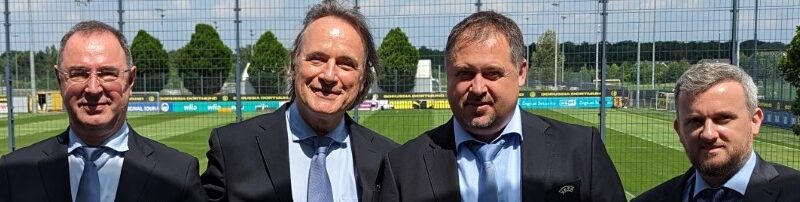
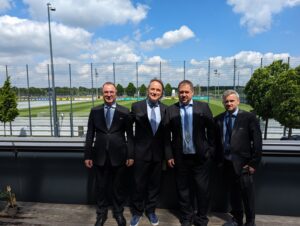 There are photographs that capture much more than the moment itself.This one, taken on 23 May 2024, shows us during one of the last missions in the former UEFA Doping Control Officer uniform. Soon after, the new uniforms arrived. Some colleagues liked them immediately. Others, myself included, felt that the previous ones had a particular elegance — discreet, formal, almost diplomatic. They looked like what the role often requires us to be: calm, precise, neutral and professional.
But uniforms are only the surface of a much deeper story.
For me, the change of uniform symbolises something larger: the evolution of UEFA’s medical and anti-doping culture. Not a break with the past, and certainly not a judgment that what came before was weaker. On the contrary, the strength of UEFA’s current system rests on the foundations built over many years by people who understood that anti-doping is not only about testing, rules and sanctions. It is also about trust, education, medical judgment, athlete welfare and the credibility of football itself.
For many years, Marc Vouillamoz was one of the central figures of that development. I have often said — sometimes so openly that a few people disagreed with me — that he built one of the strongest anti-doping teams in international sport. That is, of course, my personal assessment, but it is based on years of working inside the system and seeing its standards in practice since 2003. UEFA’s anti-doping programme has not been improvised. It has been structured, demanding and continuously improved: DCO candidates undergo comprehensive training and assessment, DCOs are re-accredited annually through practical and written assessment, and they are audited over a four-year cycle. UEFA’s 2023/24 anti-doping information listed 53 DCOs from 28 countries, a scale that speaks not only about administration but about a real international professional network.
That network matters. A good doping control officer is not merely a person who follows a checklist. A good DCO represents the authority of the system while respecting the dignity of the athlete. He or she must be precise but not arrogant, firm but not insensitive, independent but not isolated from the medical and ethical context of sport. In that sense, the old uniform was never just clothing. It represented a professional culture.
Yet football has changed. Sport has changed. Medicine has changed. Anti-doping has changed as well.
Today, clean sport cannot be protected only by collecting samples. It requires intelligence, data, education, medical expertise, scientific interpretation and dialogue with those who work closest to players. UEFA has clearly moved in that direction. Even in the official anti-doping programme, we can see this shift: intelligence, investigation and IT are now explicitly part of the system, with machine learning being developed to predict higher-risk matches and players.
This is where the arrival and leadership of Dr Zoran Bahtijarević added another important layer. Not because the previous period lacked quality, but because an already strong system gained a more visible scientific and medical dimension. With Zoran, UEFA Medical and Anti-Doping increasingly became not only an operational body but also a scientific platform. At the last meeting, I said something I still believe: UEFA has developed something that very few, if any, international sports federations possess in such a structured way — science in the service of sport.
That phrase is important. Science in the service of sport does not mean science used as decoration, or as a public relations slogan. It means asking better questions. It means testing assumptions. It means creating space where doctors, researchers, physiotherapists, sport scientists, anti-doping experts, football administrators and athlete representatives can meet and challenge each other. It means accepting that modern football medicine must deal with injuries, load, recovery, women’s health, pain management, mental health, anti-doping, education and ethics — all as connected parts of the same ecosystem.
UEFA’s own medical activities show this direction clearly. The ninth UEFA Medical Symposium in Lugano brought together more than 500 medical professionals from Europe and beyond to discuss football-related scientific research, and UEFA described it as the ninth edition of a biennial symposium dedicated to key medical issues in the game. Importantly, the 2025 event also expanded participation beyond national associations to clubs, European Leagues and FIFPRO Europe, and included physiotherapists for the first time. This is exactly the kind of opening that football medicine needs.
The same direction can be seen in the UEFA Medical and Anti-Doping Research Grant Programme. For 2026, UEFA describes the programme as a way to promote medical, health, performance and anti-doping research in European football. The programme includes themes in women’s football, men’s football, support staff, anti-doping social science and anti-doping natural science, with total funding of €150,000 and individual awards of up to €30,000. Its stated aim is to create impactful and translatable knowledge that improves evidence-based decision-making in European football.
This is not a cosmetic change. It is a cultural change.
For years, I felt that UEFA should not leave scientific debate about football only to external conferences and independent platforms, however valuable they may be. I attended excellent scientific meetings where football was discussed seriously, but I always thought: why should UEFA not be the natural umbrella for this? Why should the governing body of European football not also be the place where different scientific opinions meet?
For many years, important scientific discussions on football medicine also took place outside the formal structures of football governing bodies.
The Isokinetic Conference, for example, has been organised since 1992 and describes itself as the world’s largest conference in football medicine, gathering thousands of professionals from more than 90 countries and bringing together sports medicine, physiotherapy, sport science, orthopaedics and rehabilitation. The “Football is Medicine” platform is another important example: established by Professor Peter Krustrup and colleagues, it has grown into a global scientific forum focused on football and health, with annual conferences, workshops, coaching courses and research collaboration.
One of the most influential examples, much closer to me personally, was the World Congress on Science and Football, closely associated with the work of Professor Tom Reilly. It was a truly multidisciplinary meeting, not limited only to association football, but open to different football codes, including rugby. I remember the 6th World Congress on Science and Football in Antalya in 2007, where I had the honour of serving on the scientific jury for the best poster award — a prize that went to my now-colleague İlker Yücesir.
These external platforms played an important historical role. They created space for discussion before governing bodies fully embraced the idea that football medicine should be a scientific meeting point, not only a medical service.
But now UEFA is no longer only a participant in this wider football medicine conversation. It is becoming one of its central meeting points.
The involvement of Professor Evert Verhagen is a strong example of this shift. His work represents exactly what modern sport needs: epidemiology, injury prevention, implementation science and a willingness to translate research into practice. UEFA’s recent scientific outputs also show how broad the medical agenda has become. For example, the UEFA consensus statement on menstrual cycle tracking in women’s football, published in BMJ Open Sport & Exercise Medicine, provides evidence-informed guidance while also acknowledging uncertainty and avoiding simplistic claims about performance or injury risk. That is the right scientific attitude: useful, practical, but careful.
And this is perhaps the main point.
Good medicine in football is not about pretending to know everything. Good football medicine is about creating a system that can ask questions honestly, collect evidence responsibly and change practice when evidence demands it. The same is true for anti-doping. The strongest anti-doping programme is not the one that only punishes. It is the one that prevents, educates, detects, protects, explains and earns trust.
That is why I do not see the new UEFA DCO uniform as a loss, even if I personally still prefer the elegance of the previous one. The old uniform belonged to a period that deserves respect. It represented discipline, professionalism and tradition. But if the new uniform belongs to a period in which UEFA Medical and Anti-Doping becomes even more scientific, more open, more evidence-based and more connected to the daily reality of football, then the change is worth it.
Because in the end, the uniform is not the essence.
The essence is the people who wear it.
The essence is the team built over many years, from Marc Vouillamoz’s organisational strength to Zoran Bahtijarević’s medical and scientific vision. The essence is the DCO who arrives quietly, performs the mission correctly and leaves without drama. The essence is the doctor who protects the player. The essence is the researcher who questions dogma. The essence is the federation that understands that protecting football means protecting health, fairness, credibility and knowledge.
So yes, maybe the old uniform was more elegant.
But in the end, the uniform is not the essence.
The essence is the people who wear it.
We have moved forward.
Dedicated with respect and gratitude to Marc Vouillamoz, Dr Zoran Bahtijarević, Professor Tom Reilly, Professor İlker Yücesir, and all my UEFA anti-doping colleagues.